
Introduction: Generative Slop
The evolution of digital art and new media practices has consistently challenged and redefined the parameters of authorship, spectatorship, and the very definition of artistic creation. Today, this trajectory intersects with the rise of generative AI, introducing a new agent into the creative dialogue: the algorithmic model guided by human prompt-engineering. This intersection, however, is increasingly framed by a pejorative term: “Slop.”
Originally used to describe low-quality, often automated digital content, “slop” has become a convenient, catch-all label for AI-generated imagery deemed unskilled, uncreative, derivative, and ultimately soulless. The metaphor is potent and deliberate; like its namesake—the bland, nutritionless feed for livestock—it signifies worthless filler, digital noise that pollutes our visual culture and represents a hollowing out of human creative labour, a phenomenon we might term “workslop.”
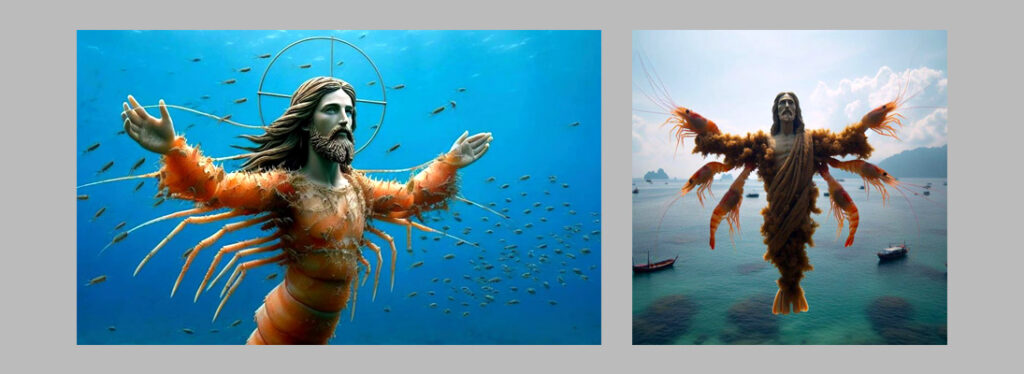
Image: AI-generated images of “Shrimp Jesus” proliferated on Facebook, 2024 (Wikipedia)
The discourse surrounding AI-generated imagery is thus dominated by a lexicon of dismissal: “lazy,” “uncritical,” “derivative,” “recycled,” “spam,” and “cheap.” These terms, while often apt for a vast sea of generic output, function to unframe the entire field, precluding a more nuanced and critical engagement with the medium. They collapse a complex technological and artistic medium into a monolithic category of failure, neglecting to interrogate its potential or to distinguish between its most banal applications and its more thoughtful explorations.
My upcoming body of work, World of Slop, seeks to intervene precisely at this point of discursive collapse. The project does not aim to defend “slop” as an aesthetic, but rather to interrogate the term itself as a cultural symptom, exploring the complex and dynamic questions it raises and investigating how these new technological possibilities might be reframed as a meaningful contemporary practice.
Project #001
MANIFESTO
World of Slop: A Love Letter to the Digital Dumpster Fire
Welcome to the World of Slop. The name is not an accident; it’s a declaration. This is the primordial ooze bubbling up from the collective subconscious of the machine, filtered through the fractured prompts of a human co-conspirator. You’ve found its official seepage on OpenSea—a gallery, a landfill, and a protest sign, all rolled into one.
The internet is drowning. A relentless, algorithmically-engineered tsunami of “content”—beige landscapes, hyperbolic anime warriors, and strangely-fingered fantasy portraits—floods our feeds. Purists clutch their pearls (and their paintbrushes), wailing about the “soulless slop” desecrating the sacred halls of Art. They preach a gospel where true expression exists only in the grunt of effort, the smell of turpentine, the sacred synapse firing between a trembling finger and a waiting canvas. It’s a beautiful, archaic fairytale. We’ve decided to pour gasoline on it and roast some digital marshmallows over the flames.
World of Slop is a controlled experiment in aesthetic pollution. I asked an AI, that vast, uncanny mirror of our own data-trails, to generate the most “popular” collectible NFTs based on its own interpretation of five loaded themes: Rebellion, Identity, Belonging, Future, and Nostalgia. The results are exactly what you’d expect and also profoundly bizarre: a hyper-saturated, commercially-optimized fever dream. It is slop. Glorious, provocative, deeply ironic slop.
But here’s the heretical position: this slop is my slop. The AI is not the artist. It is the newest, most confounding tool in the shed—a cybernetic brush, a collaborative phantom limb. The artist’s role has shifted from sole progenitor to curator, provocateur, and prompt-wrangler. The art happens not in spite of the machine, but in the tense, humorous, and deeply political dialogue with it. It happens in the choice of theme, the framing of the prompt, and the defiant act of presenting this output as a commentary on the very economy of desire it apes.
So, step right up. Gaze upon these perfectly generated tokens of Rebellion that look eerily similar. Ponder the Identity crafted from a billion data points yet belonging to no one. This is the Future tasting oddly of recycled Nostalgia. This project is a middle finger to both the cynical, profit-driven NFT mills and the dusty guardians of a romanticized artistic purity. The soul isn’t lost in the machine; it’s arguing with it in the prompt box, laughing at the output, and asking the only question that matters in this brave new world: You call this slop? Watch me make it mean something.
Generative AI: Slop or Un-slop?
My original Midjourney prompt stated: Create a digital art PFP series with a style that merged Fantasy art and Cyberpunk/Science fiction with themes of Rebellion, Identity, Belonging, Future and Nostalgia. These themes according to Deepseek in the PFP (Profile Picture) collectible sub-culture are the most full-proof strategy for creating an NFT business for $10,000 in sales per month. Although this project does not follow the entirety of the “execution roadmap” set out by Deepseek due to the technical and monetary constraints, it does try and remain true to the original idea in generating the artwork.
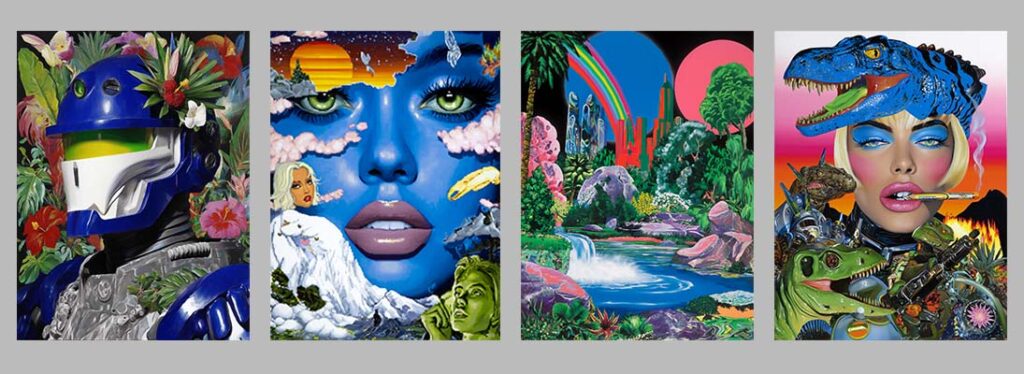
Image: These are the original four images which were continually generated to create variants within each collection they are Bad Robot, Future Sublime, Don’t Go Chasing Waterfalls, and Rebel Without A Cause. These titles are of my own making, where I felt I needed to set the framing and meaning of the collection, rather than using AI to generate the tone.
World of Slop: Project #001 continues my sustained inquiry into the fraught relationships between art, design, and the capitalist market—specifically, how an artist navigates and positions themselves within a system that has historically been at odds with the production of avant-garde or critically challenging work (see Hire Me Out, 2000, Christopher Howlett Enterprise, 2006-10). In an era where everything seems permissible and instantly co-optable, the very notion of a critical avant-garde can feel anachronistic, dismissed as a form of “political kitsch.”
Contemporary art success remains largely tethered to the commercial gallery system and its attendant market logics. However, the recent, volatile history of NFTs and the rise and fall of their associated collecting subcultures have laid bare both the speculative nature of the digital art market and a desperate, often uncritical, hunger for the new. This project positions itself within this rupture, asking: how does an artist create work that is critically engaged with its own technological medium when the primary frameworks for validation are either wholesale dismissal or uncritical market speculation? By embracing and re-contextualising the aesthetics and processes of “slop,” this project aims to forge a critical path through the noise, proposing a model of practice that is self-aware, economically conscious, and artistically rigorous.
This is the original Deepseek prompt:
Create a full-proof strategy for making $10,000 in sales per month of NFTs. Focus on the most popular and successful content and subject-matter that digital artists have created over the past 5 years. This also includes creating a year-long marketing strategy that cuts across multiple digital platforms which will advertising and promote the creation of these new NFTs. Begin with a concise checklist (3-7 bullets) of steps you will follow to complete this task, focusing on conceptual planning rather than details.
Highlight what makes the most successful NFTs online and convert these high monetary online sales into another checklist (3-7 bullets) such as how many where minted, the amounts in any one drop, what countries bought them, what types of imagery was used, etcetera… Cross-check most successful NFT’s names and details with reliable news outlets and digital design Resources. Optimize for clarity, concise presentation, practical or hidden value that most people have not understood.
Return the results as a properly formatted narrative paragraph with bullet points, tables, graphs and numbered steps to achieve the outcomes over the course of a year.
The final number generated for each collection became an arbitrary number based off the ending for my subscription to Midjourney. Once all of my credits were used up, I could not afford to renew my subscription. This ended the generative side to the project which in turn ended the run for each collection. The following pages examine each collection in detail.